

Notice
Notice
Digital twin for drinking water distribution networks
Dec 15, 2025
Not long ago, managing a water network meant working with “snapshots”: occasional readings, late alerts, and decisions made with incomplete information. Today, operators need something different—real-time visibility, the ability to anticipate issues, and a simple way to connect what happens in the field with what they see on the map. That need is exactly why Dynamic Waterflow Map was created: a water digitalization platform designed to turn the network into a living, actionable system.
The Dynamic Waterflow Map project has been boosted thanks to funding from the Regional Ministry of Innovation, Industry, Trade and Tourism (Conselleria), under Spain’s Recovery, Transformation and Resilience Plan, financed by the European Union – NextGenerationEU.
The story begins on the pipeline itself. Our fiber-optic sensing technology enables a distributed sensor network along the infrastructure, delivering measurements at intervals of less than 5 meters. By combining this field layer with other data sources, operators no longer have to “hunt” for problems—the network starts to speak.
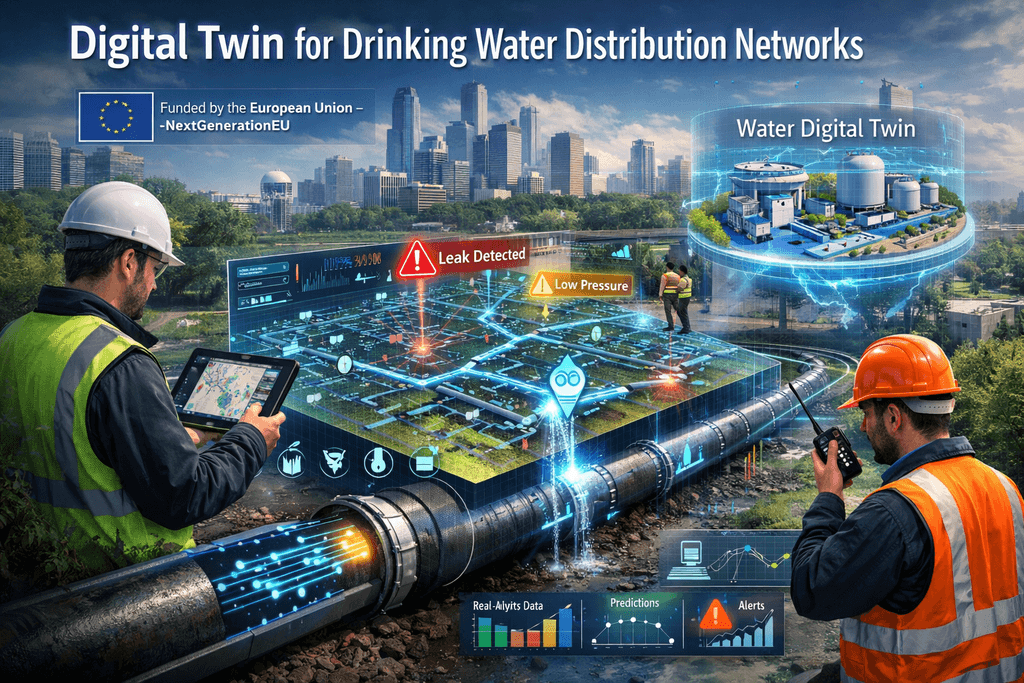
In day-to-day operation, the platform brings together data on water leaks, pressure, flow, water quality, weather conditions, and operational incidents, along with the geospatial location of sensors and network assets (pipes, valves, air valves, and more). Everything is displayed on a digital map that doesn’t just visualize data—it understands it. That’s the real differentiator: a decision-oriented water digital twin.
Thanks to this funding boost, we’ve strengthened the platform’s intelligent capabilities, making it a reliable tool for real-time water network monitoring—ideal for utilities, irrigation communities, and public institutions looking for control, speed, and evidence-based decision-making.
Because managing water is no longer about reacting. It’s about anticipating.
INTECA/2025/059

Not long ago, managing a water network meant working with “snapshots”: occasional readings, late alerts, and decisions made with incomplete information. Today, operators need something different—real-time visibility, the ability to anticipate issues, and a simple way to connect what happens in the field with what they see on the map. That need is exactly why Dynamic Waterflow Map was created: a water digitalization platform designed to turn the network into a living, actionable system.
The Dynamic Waterflow Map project has been boosted thanks to funding from the Regional Ministry of Innovation, Industry, Trade and Tourism (Conselleria), under Spain’s Recovery, Transformation and Resilience Plan, financed by the European Union – NextGenerationEU.
The story begins on the pipeline itself. Our fiber-optic sensing technology enables a distributed sensor network along the infrastructure, delivering measurements at intervals of less than 5 meters. By combining this field layer with other data sources, operators no longer have to “hunt” for problems—the network starts to speak.
In day-to-day operation, the platform brings together data on water leaks, pressure, flow, water quality, weather conditions, and operational incidents, along with the geospatial location of sensors and network assets (pipes, valves, air valves, and more). Everything is displayed on a digital map that doesn’t just visualize data—it understands it. That’s the real differentiator: a decision-oriented water digital twin.
Thanks to this funding boost, we’ve strengthened the platform’s intelligent capabilities, making it a reliable tool for real-time water network monitoring—ideal for utilities, irrigation communities, and public institutions looking for control, speed, and evidence-based decision-making.
Because managing water is no longer about reacting. It’s about anticipating.
INTECA/2025/059